Power Generation
Control plant output at the point that matters—the grid connection
Control plant active and reactive power, voltage, power factor, ramps and point-of-connection behaviour with enPowerManager.
Operational problem
Renewable and hybrid plants combine multi-vendor equipment, point-of-connection constraints, local control and portfolio reporting. Visibility without a defined control boundary leaves operators with fragmented evidence and uncertain action paths.
EnergyPortal provides central operations and governed analytics, enPowerManager owns qualified plant-level control, Scadify connects and executes at the field edge, and Enlogy engineering defines integration, testing and commissioning responsibilities.
Core capabilities
Active-power and export objectives
Configured according to the project’s data, control, approval and operating boundaries.
Reactive power, voltage and power-factor modes where engineered
Configured according to the project’s data, control, approval and operating boundaries.
Setpoint authority, priority and traceability
Configured according to the project’s data, control, approval and operating boundaries.
Hybrid source allocation and ramp strategies
Configured according to the project’s data, control, approval and operating boundaries.
Fallback, communication-loss and acceptance-test definition
Configured according to the project’s data, control, approval and operating boundaries.
Products and delivery responsibilities
Assemble the operating stack around the action.
Operational workflow
From operational context to measured action.
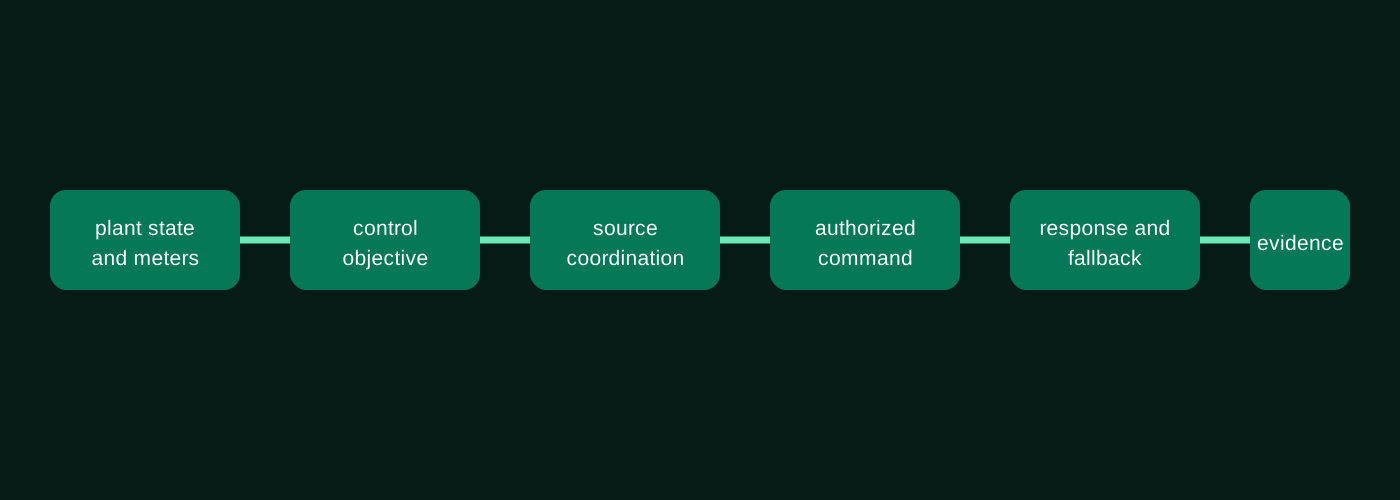
- 01Review point of connection and plant topology
- 02Define control authority and limits
- 03Acquire source and meter state
- 04Execute approved command locally
- 05Record response, exception and evidence
Data sources and integrations
Connect the evidence that explains the decision.
- Plant meters and analyzers
- Inverters, turbine and storage controllers
- Weather and irradiance stations
- Point-of-connection measurements
- Plant SCADA and dispatch context
Governance and resilience
Grid-code and TEİAŞ requirements depend on the connection agreement, applicable technical criteria and tested project configuration. Software does not create compliance automatically.
Protocol roles, OEM compatibility, data retention, control limits and failure behaviour must be confirmed from the engineering-approved release and project documents.
Outcomes and KPI framework
Measure the operating result, not only the software activity.
Traceable plant and grid-interface control
Use an agreed baseline, operational definition and evidence source before assigning a target.
Consistent data quality and operational context
Use an agreed baseline, operational definition and evidence source before assigning a target.
Clear route from alarm or setpoint to accountable action
Use an agreed baseline, operational definition and evidence source before assigning a target.
Project-specific test and acceptance evidence
Use an agreed baseline, operational definition and evidence source before assigning a target.
Solution architecture
Make responsibility visible from field to enterprise.
EnergyPortal provides central operations and governed analytics, enPowerManager owns qualified plant-level control, Scadify connects and executes at the field edge, and Enlogy engineering defines integration, testing and commissioning responsibilities. The architecture separates observation, recommendation, human-approved action and local execution so that each team can see what it owns.
Engineering and implementation
Move from architecture to accepted operation.
Engineering scope can include single-line review, control responsibility, OEM/protocol assessment, network design, FAT/SAT, commissioning, grid tests, training and lifecycle support. Exact supply and acceptance responsibility is project-specific.
Customer applications
Discuss integration, commissioning and operational support for your equipment and sites.
Plan your deployment
Coordinate wind, solar and storage at the connection point
Example operating scenario
A hybrid plant receives a power limit while available generation changes. PPC uses connection-point feedback and equipment availability to allocate setpoints within agreed plant and grid limits.
Data to prepare
Connection agreement, active/reactive power requirements, meter latency, source limits, setpoint interfaces, ramp rates and fallback states.
What Enlogy provides
Coordinated power control with traceable instructions, feedback and operating states; engineering defines the control hierarchy and acceptance tests.
Questions to ask before buying
- Where is the controlled measurement point and who owns each setpoint?
- What happens when a meter, network or source becomes unavailable?
- Are master/slave roles, ramp limits and recovery included in acceptance?
Illustrative workflow; project scope and acceptance criteria are agreed for your facility.
Standards compliance for this capability
IEC 61850 and grid interoperability
Enlogy provides full compliance with the standards below across development, integration and system operation and management.
IEC 61850 and grid interoperability
IEC 60870-5-104 (IEC-104) · IEC 61850 · IEC 61850-7-420 · IEC 61850-7-410 · CIM (IEC 61970 / IEC 61968)
Why you need it
Utilities and plant operators need consistent equipment meaning across SCADA, substations and dispatch systems.
What Enlogy provides
Enlogy connects telecontrol and equipment data models with a common asset context, preserving measurement quality, timestamps and command responsibility.
Explore this capability: IEC 61850 and grid interoperabilityRelated solutions and products
Continue with the next operational question.
FAQ
Questions to resolve before implementation.
Which control modes are available?
The applicable active, reactive, voltage, power-factor, ramp and export modes are confirmed through the project functional design and compatibility matrix.
Can enPowerManager control multiple generation technologies?
It is designed for engineered wind, solar, biomass, hydro and storage combinations; each source interface and responsibility requires validation.
What happens when communications fail?
Fallback, local mode, timeout and recovery behaviour are defined and tested per project rather than promised as a universal response.
Next step